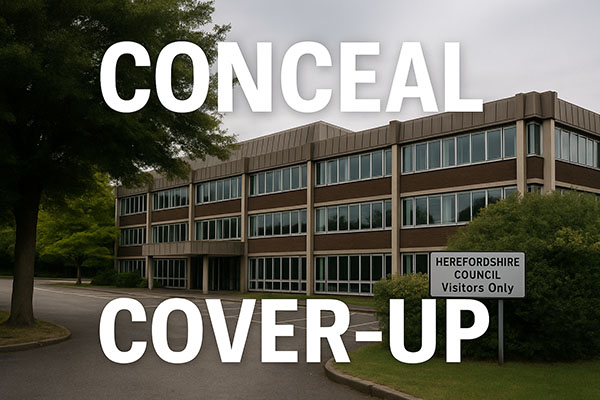
A little more evidence — this time, and once again, from inside Herefordshire Council — confirming that staff across governance, legal, and data protection were fully aware of their years of unauthorised surveillance of me.
Rather than complying with RIPA or UK GDPR, they actively disregarded legal safeguards and attempted to justify covert monitoring using false assumptions about ‘public information.’
Blatantly Misrepresenting RIPA: A Failure in Law and Oversight
Helen Worth’s email is not a misunderstanding — it is a recorded example of Herefordshire Council internally discussing surveillance of me, then attempting to justify it without lawful basis or internal authorisation. She admits outright that she doesn’t “know a lot about RIPA” — yet still proposes a formal Subject Access Request response based on her own assumption that RIPA does not apply to information I made “public.” This is not just inaccurate, it is legally reckless.
The idea that covert surveillance is exempt from regulation simply because it targets content on social media is entirely false, and has been explicitly rejected by the European Court of Human Rights in Catt v United Kingdom (2019). In that case, the Court ruled that even publicly observable behaviour — if monitored, recorded, or retained by a public authority — engages privacy rights and must be proportionate, authorised, and legally justified. Herefordshire Council’s internal stance — as shown above — utterly fails to meet that standard.
Where Were the Council’s Legal Officers?
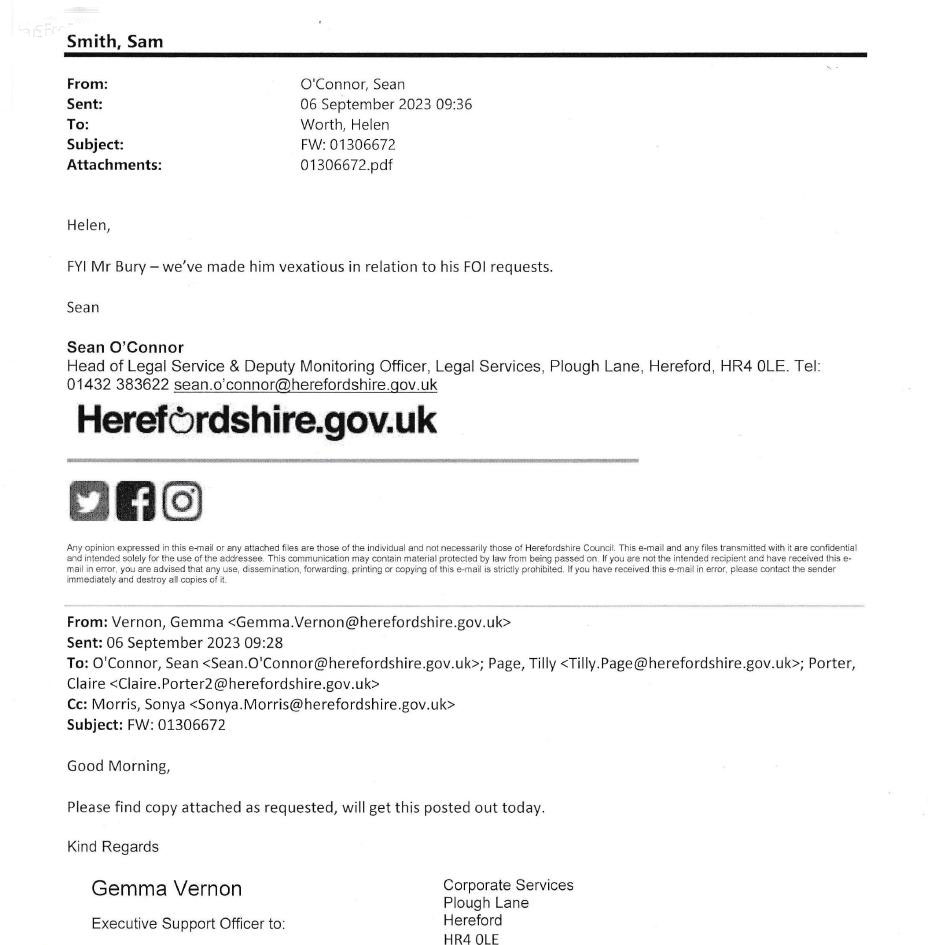
This communication raises an immediate and serious question: Where were Sean O’Connor and Claire Porter? As the Council’s legal adviser and Monitoring Officer respectively, both were responsible for ensuring lawful handling of SARs and for intervening when staff proposed responses that plainly failed to meet legal standards. Yet neither corrected the record. Neither stepped in to stop surveillance. Neither ensured disclosure. Instead, both continued to deny wrongdoing, Porter misrepresent the facts to regulators, O’Connor actively label one of my SARs, that I know of, and data protection concerns as “vexatious.”
In doing so, they not only failed in their duties — they obstructed justice.
A Pattern of Obstruction the ICO Chose to Ignore
This internal email was not disclosed to me when I submitted a Subject Access Request, gathering evidence for a case— nor was it made available to the Investigatory Powers Tribunal, despite being directly relevant to my complaint regarding years of unauthorised monitoring. It only surfaced much later, and certainly not with the assistance of the ICO.
Ms Alison Fletcher, the ICO officer assigned, at the time, to investigate my complaint regarding a SAR and Herefordshire Council’s concealment of surveillance data including logs, should have acted to secure this evidence. Instead, she adopted a passive and non-objective stance, claiming she could not determine whose version of events was accurate. She refused to investigate, refused to challenge the Council’s account, and refused to apply established case law — despite being provided with specific and relevant material supporting my claims. This included material that clearly met the legal definition of personal data as established in Durant v Financial Services Authority [2003], which requires that data both relate to an individual in a biographical sense and have them as its focus.
Her failure to act was not procedural delay — it was a deliberate refusal to engage with the evidence.
The result? A clear and verifiable record of internal misconduct was ignored. The ICO failed to do its job, and in doing so, enabled the destruction of crucial evidence and cover-up to continue.
The Silence of Senior Officers
What makes this email even more serious is who wasn’t included or responding to it.
As Monitoring Officer and Data Protection Officer, Claire Porter was legally responsible for ensuring SARs were lawfully processed and that internal staff understood their obligations under RIPA and UK GDPR. There is no indication that she intervened, or corrected this response, or ensured proper authorisation processes were followed. Her silence in the face of unlawful surveillance was not ignorance — it was a neglect of statutory duty and an act of active obstruction.
Sean O’Connor, the Council’s principal legal adviser, later denied any wrongdoing by the Council and even went so far as to label my continued attempts to access this type of evidence as “vexatious.” That claim is indefensible. The email above an example and confirms the Council was discussing surveillance, knew it was being raised in a SAR, and responded with a justification that was both factually and legally flawed. O’Connor’s later denials and aggressive correspondence were not just misleading — they were professionally indefensible.
Both Porter and O’Connor had repeated issued ‘Unreasonable behaviour’ policy letters and restricted communication for my pursuit or data and requests for assistance from councillors.
Conclusion: Evidence They Tried to Bury
This email was withheld, ignored, and only surfaced in December 2024, — many months after the Investigatory Powers Tribunal had concluded. It was disclosed by Herefordshire Council in response to a separate Subject Access Request. It was not disclosed earlier by the Council — like much of what I lawfully requested — not by the ICO, and not during proceedings before the Investigatory Powers Tribunal. Its content confirms that internal staff, senior legal officers, and regulatory bodies all played a role in concealing unlawful surveillance and obstructing my access to justice.
The cover-up was coordinated.
The accountability is overdue.
And this is only part of the record.
Internal emails, server logs, and other records confirm Herefordshire Council monitored my online activity without RIPA authorisation, in breach of privacy case law including Catt v United Kingdom — and the ICO failed to adequately investigate, enabling a coordinated cover-up.
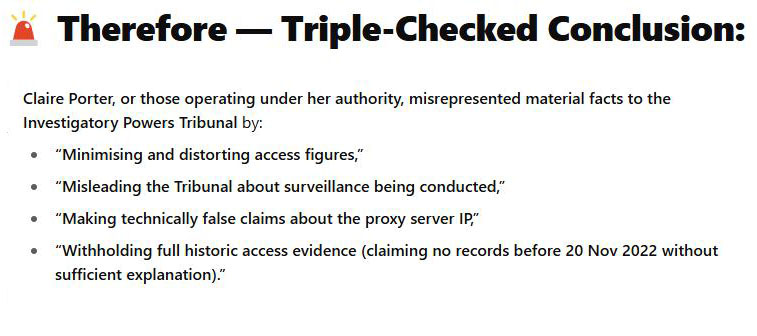
Herefordshire Council Didn’t Just Make Errors — They Misled a Tribunal
In its formal submission to the Investigatory Powers Tribunal dated 2 November 2023, Herefordshire Council:
-
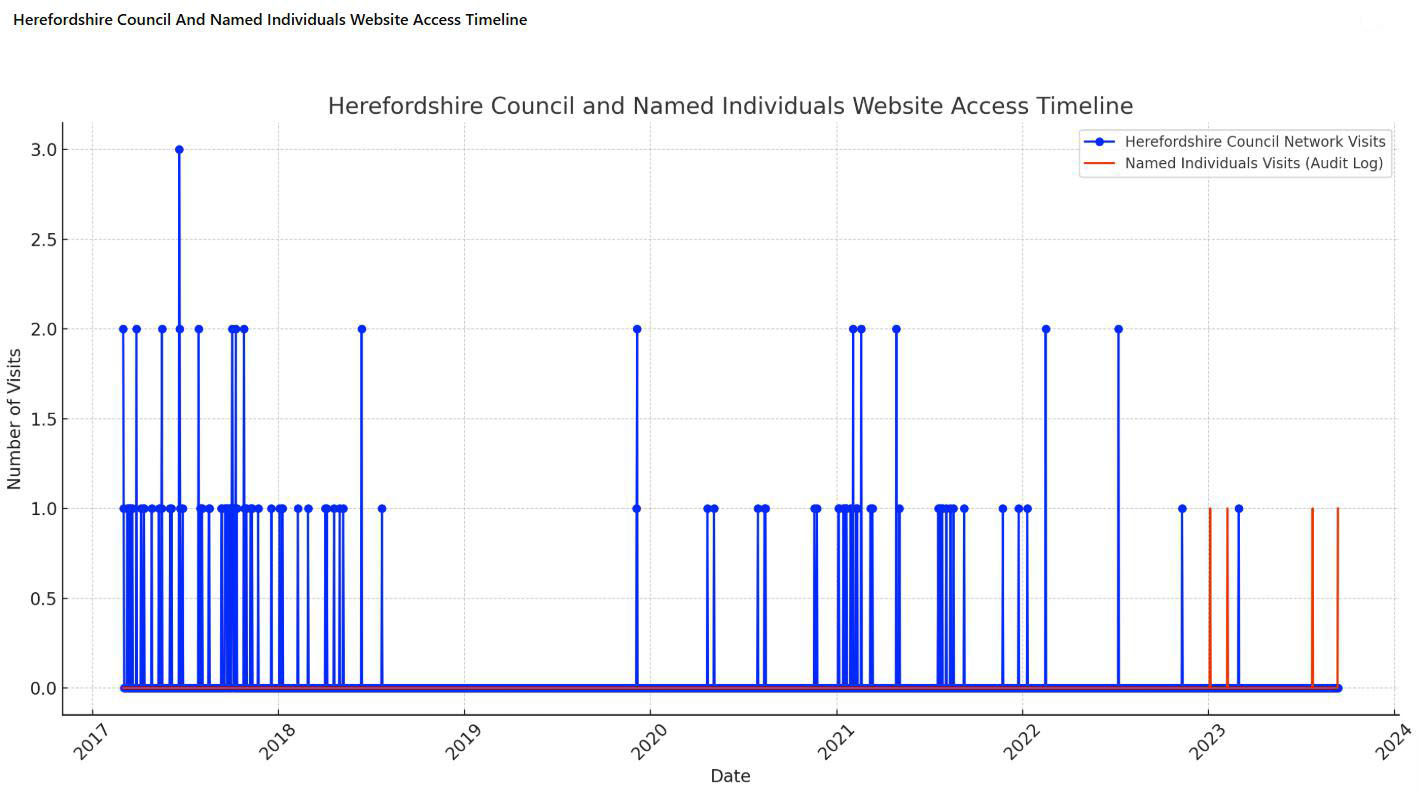
Underreported known data available from its internal network and proxy logs
-
Falsely narrowed the number of staff involved and the extent of surveillance incidents
-
Attempted to deflect blame onto an external proxy provider, despite technical evidence confirming internal Council activity
These are not honest mistakes. They are deliberate misrepresentations made in a judicial setting — a calculated attempt to mislead the Tribunal and obstruct justice.
This deception was allowed to stand because the Information Commissioner’s Office failed to intervene. ICO staff, including Ms Alison Fletcher, were repeatedly made aware of missing data, internal contradictions, and breaches of RIPA and UK GDPR. Yet they refused to investigate, secure the evidence, or apply the law.
You may wonder or ask: “Why do I continue to pursue this matter?”
The answer is simple:
What occurred was not merely a regulatory oversight — it was a systemic failure in accountability.
The Council abused their powers, conducted unauthorised and unlawful surveillance and monitoring, and lied.
The ICO looked away.
And a Tribunal was deceived and misled because of it.